You have decided to process your own feed. Now you have to decide what to buy, and the choice between a roller mill and a hammer mill is only half of it. The other half is whether you need a machine that mixes, or one that just grinds.
A grinder mixer does both jobs in one PTO-driven machine. It grinds grain, blends it with supplement in a mixing tank, and unloads the finished ration where you need it. A standalone hammer mill on its own only grinds.
Art’s Way has built grinder mixers since 1956, when Iowa farmer Arthur Luscombe built the first one on his place near Dolliver. We still build them in Armstrong, Iowa, in both mill configurations, which is why we can make this comparison honestly.
Do you need mixing, or just grinding?
Answer this before you look at a single mill.
If you are building a complete ration of corn, supplement and minerals, you need mixing. A grinder mixer handles the whole process. Every Art’s Way grinder mixer runs the same 12 inch mixing auger and a 21 by 24 inch supplement hopper.
A standalone hammer mill is great for grinding only, or if you already have mixing capabilities.
| Grinder mixer, hammer mill | Grinder mixer, roller mill | Standalone hammer mill | |
|---|---|---|---|
| Mixes a full ration | Yes | Yes | No |
| Grind control | Screen swap, 14 sizes | Roll gap and tooth pattern | Screen swap, 14 sizes |
| Mill speed | 2,800 to 3,000 RPM | 540 RPM | 2,800 to 3,000 RPM |
| PTO | 540 or 1000 (8215 is 1000 only) | 540 only | 1000 or electric (stationary), 540 or 1000 (portable) |
| Horsepower | 40 to 180 by model | 40 to 120 by model | 40 to 60 stationary, 60 to 180 portable |
| Tank capacity | 105 to 215 bushels | 105 to 165 bushels | No tank |
| Models | 6105, 6140, 7165, 8215 | CATTLEMAXX 6105, 6140, 7165 | Stationary, Portable |
We do not build a standalone roller mill. If you want your corn rolled or cracked, that comes as a CATTLEMAXX grinder mixer.
The 215 bushel 8215 is hammer mill only.
See the full line on our feed mill equipment page, and the standalone units under hammer mills.
Roller mill vs. hammer mill for cattle and hogs
We build both mills on the same machine. The 6105, 6140 and 7165 each come as a hammer mill or a CATTLEMAXX roller mill, with the same tank and mixing auger.
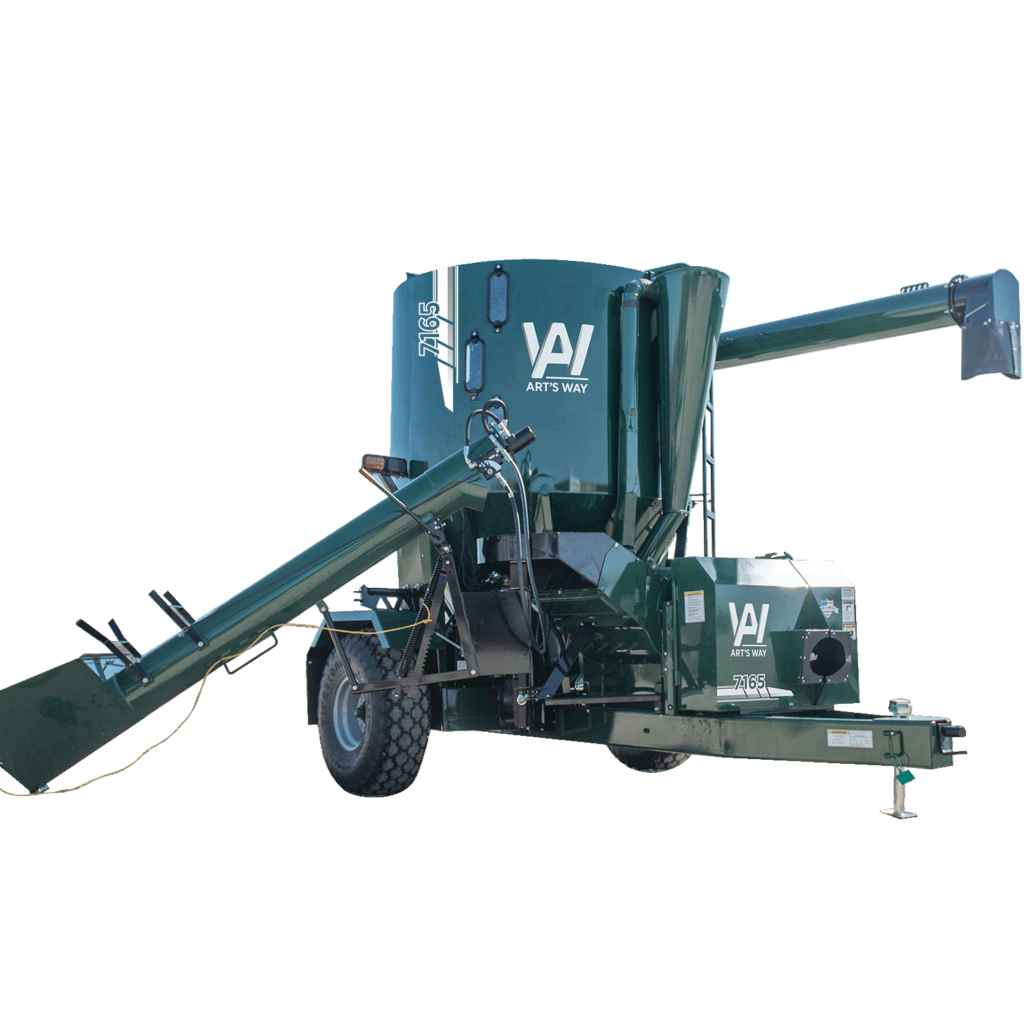
A hammer mill grinds. Hammers spinning at 2,800 to 3,000 RPM drive the grain through a screen, and the screen sets the particle size. There are 14 screens, from 3/32 of an inch to 2 inches. Coarse screens crack, fine screens grind. This makes it a versatile machine ready to feed a wide range of livestock.
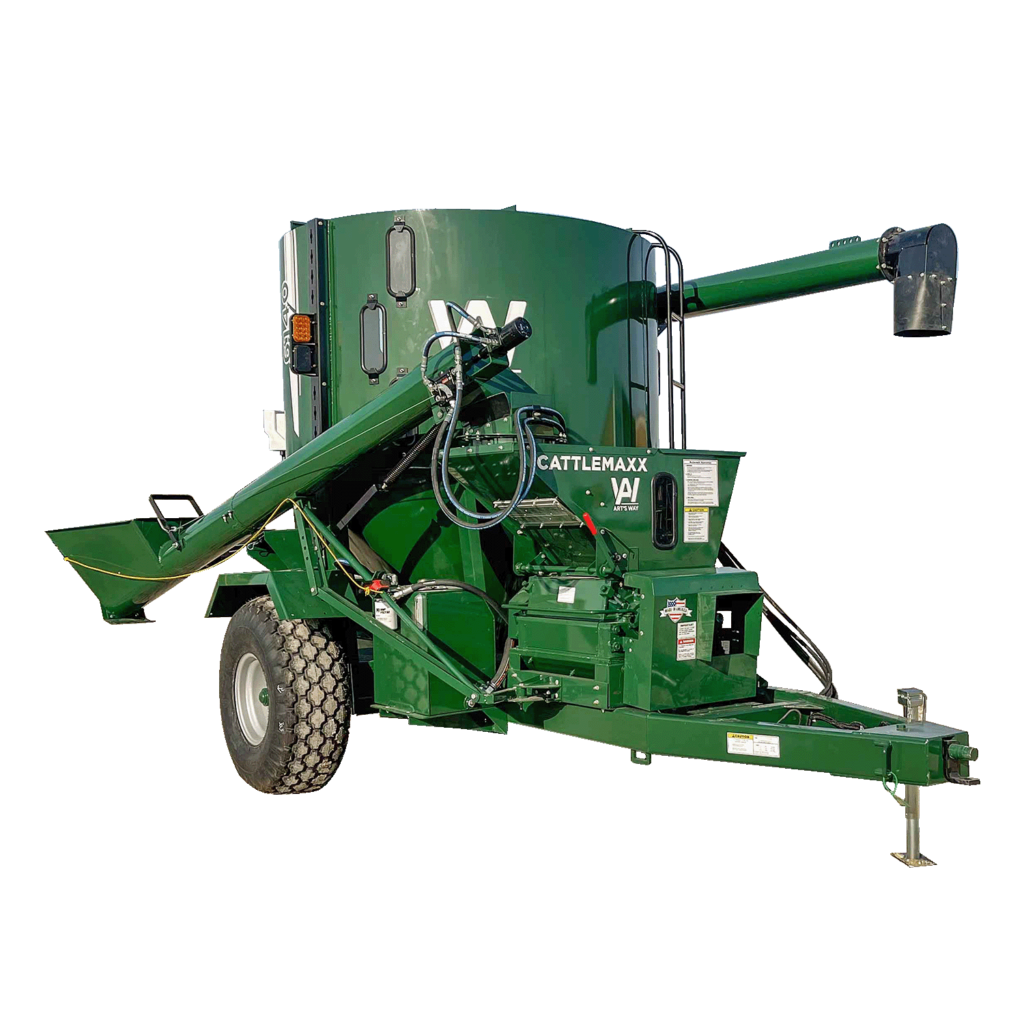
A roller mill cracks and rolls. The rolls turn at 540 RPM and the grain passes between them. You get a more uniform particle size and less dust. Grind size comes from the roll gap and the roll pattern: flat or sharp tooth, in 5, 7 or 10 grooves per inch. Flat tooth wears longer and suits cracking, crimping or flaking. Sharp tooth carries a higher capacity rating and grinds finer.
Dairy cattle prefer a finer feed, so we’d suggest a hammer mill. A roller mill is better suited for beef cattle, who prefer cracked corn. Ask your nutritionist what grind your ration calls for, then pick the mill that hits it.
One more difference to know before you choose: our roller mills run on 540 PTO only.
Compare the roller mill models against the hammer mills, or read our earlier take on choosing a roller mill or hammer mill grinder mixer.
What size do you need?
Tank capacity sets the size of every batch. Art’s Way grinder mixers come in four tank sizes:
- 105 bushels: 6105 and CATTLEMAXX 6105
- 140 bushels: 6140 and CATTLEMAXX 6140
- 165 bushels: 7165 and CATTLEMAXX 7165
- 215 bushels: 8215, hammer mill only
The right tank depends on your ration and your herd, and those are different on every operation. Our grinder mixer calculator will run your own numbers, and your dealer can help you match a tank to your operation.
Will your tractor run it?
This question undoes the most deals. Check PTO speed first, because it is not negotiable, then horsepower:
| Model | PTO speed | PTO horsepower |
|---|---|---|
| 6105 | 540 | 40 to 100 |
| 6140 | 540 or 1000 | 40 to 100 |
| 7165 | 540 or 1000 | 80 to 160 |
| 8215 | 1000 | 100 to 180 |
| CATTLEMAXX 6105 | 540 | 40 to 100 |
| CATTLEMAXX 6140 | 540 | 40 to 100 |
| CATTLEMAXX 7165 | 540 | 50 to 120 |
What you are buying when you buy new
A grinder mixer runs most of the year, runs loaded, and turns its mill at 3,000 RPM. On a machine like that, shaft imbalance means vibration, and vibration wears out bearings early. That is why we balance shafts on a dynamic balancer instead of by hand.
We still build with thick steel, cut on a high-definition CNC plasma, and since 2021 our repetitive welds run through three robotic weld cells. The hammers are four-way reversible, so you get several fresh faces from a set. Parts come through your dealer, from the company that built the machine. For upkeep, our dealers shared the four things worth watching on a grinder mixer.
A used grinder can be a good buy. Many of the service parts are available today, for grinders built in the 50s and 60s.
What to bring to your dealer
Art’s Way sells through independent dealers, so the next step is a conversation. You will get further, faster, if you show up with five things:
- What grain you are feeding, and to what species
- Your batch size or herd size
- Your tractor’s PTO horsepower, and whether it runs 540, 1000 or both
- Whether you need mixing or just grinding
- How high and how far you need the unload auger to reach
Arthur Luscombe built his first PTO grinder mixer because he wanted a better one than he could buy. We still build the same high-quality grinder mixers in Armstrong, Iowa today.
Ready to talk through your setup? Find your local Art’s Way dealer and bring that list with you.